
Federal fisheries minister, Indigenous leaders gather at Nechako River construction site
Dominic Frederick’s 30-year dream of establishing a Prince George fish hatchery to help salmon thrive in local rivers for generations to come is about to become a reality.
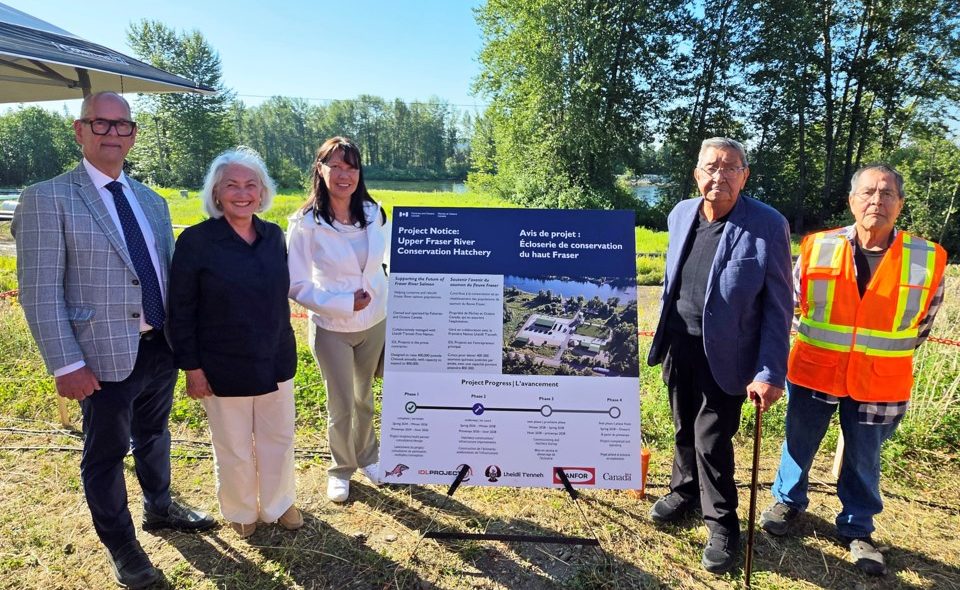
The Lheidli T’enneh First Nation fisheries manager attended a ceremony Tuesday, Aug. 25, on the north shore of the Nechako River to announce the federal government’s $38-million investment in the Upper Fraser River Salmon Conservation Hatchery.
The hatchery, a joint venture between the Lheidli T’enneh and Canfor, is located near the confluence of the Nechako and Fraser rivers and is focused on rebuilding BC’s depleted Chinook salmon populations. When it opens in spring 2028, the facility will have the capacity to raise 400,000 salmon fry annually, with room to expand to enhance other salmon species and return them to the river for their downstream journey on the Fraser to the Pacific.
“To me it means more to the younger people who are going to be working here. It’s about the next generation,” said Frederick, whose efforts to establish Indigenous-led fisheries teams to enhance salmon revitalization and restore fish habitat date back to his time as Lheidli T’enneh chief, from 2004-19.
“We need it just to replenish some of the stocks that have been depleted, and it’s going to be a good facility for learning for the university, for the schools and for other people and other nations to come and see what’s going on, to learn about the life cycle of the resource we value so much.”
The Prince George hatchery will include an administration building, egg incubation rooms, laboratory space, interior and exterior fish tanks and a workshop. IDL Projects is building it on a site just east of Northern Lights Estate Winery. The facility will be owned and operated by the Department of Fisheries and Oceans and partially managed by the Lheidli T’enneh.
Fisheries Minister Joanne Thompson travelled to Prince George from her home in St. John’s, N.L., for Tuesday’s event. She said human intervention is needed to rebuild the province’s salmon stocks, which are threatened by rising stream and ocean temperatures and other environmental factors affecting watersheds.
“Pacific salmon are under pressure, the climate is changing, the habitat is changing and salmon are facing new challenges in every stage of their cycle, and this highlights the importance of ongoing conservation and stewardship efforts,” said Thompson.
“After decades of historic declines, there have been some encouraging signs of recovery among sockeye, Chinook and pink salmon populations in British Columbia, including the Fraser River. And while this is reason for some cautious optimism, it is not a reason to ease off. The work continues on habitat, hatchery and harvest measures, while at the same time integrating science, Indigenous knowledge and local expertise in the management of these fisheries.”
Chief Dolleen Logan said she is thrilled the hatchery is being built in her nation’s territory for the benefit of all Canadians.
“For Indigenous people, salmon are not simply a resource, they are our relatives, they are part of our culture, our identity, our laws, our responsibilities,” said Logan. “The health of the salmon reflects the health of the land, the water and our communities.
“For thousands of years Indigenous nations managed fisheries through stewardship practices rooted in observations, respect and balance. We understand that caring for salmon meant caring for the entire watershed. Our traditional knowledge teaches us that abundance comes from responsibility, not exploitation. Today those teachings are more important than ever.”
Hatcheries give fish a strong start by increasing the chances of eggs surviving, but Logan said that does not guarantee healthy salmon runs.
“Restoration of salmon habitat remains essential,” said Logan. “Salmon need healthy rivers, functioning floodplains, cool water, stable spawning grounds and resilient ecosystems, and that is why our work continues far beyond today’s announcement.
“Lheidli T’enneh is actively enhancing habitat restoration throughout our territory. We also work to create opportunities that allow proponents and developers to contribute meaningful restoration efforts. It was a very proud moment when another local First Nation, Lhtako Dene, invited our fisheries team to go down there and train their nation on how to do it. We’re sharing knowledge and this is how we’re going to sustain our fish.”
The four-phase project is expected to create about 100 construction jobs. Operating the hatchery will require 10 to 15 full-time employees and several part-time workers.
Steve Gotch, the BC/Yukon area director for the Department of Fisheries and Oceans, described the fish hatchery as a maternity ward for fish.
“We collect wild salmon from various areas in the Fraser River watershed and we’ll bring the eggs and milt (male reproductive fluid) to the facility and basically raise them in a safe environment with controls over the water temperature and the conditions they’re exposed to. We hold them for the least amount of time as possible,” said Gotch.
“From a human intervention perspective, we want to maintain the wildness of these salmon. A hatchery facility is so effective because typically in the wild the survival to fry stage is upwards of 30 per cent. That’s due to storms that might occur while the eggs are incubating or some sort of habitat disruption or predation. In a hatchery facility, we can easily see upwards of 90 to 95 per cent survival.
“We’re helping the salmon survive that early life stage to help them rebuild the fish population.”
Thompson announced two other BC hatchery projects Tuesday, one on the Chilcotin and the other in the Skeena watershed.
The Tsilhqot’in National Government will operate a $7.5-million Chilcotin River Salmon Hatchery near Hanceville, 98 kilometres west of Williams Lake. Industra Construction will build the facility, which will have the capacity to raise 250,000 Chinook fry per year.
The $7.5-million Wilkp’Ho Dix Hatchery on the Kitwanga River, 486 kilometres northwest of Prince George, will be built by Progressive Ventures Construction in partnership with the Gitanyow Nation. It will focus on improving sockeye salmon stocks and will be operated by Gitanyow people, with an initial capacity to raise 300,000 juvenile sockeye and room to expand to 400,000.
“This hatchery is something that will be very important to our people,” said Gitanyow hereditary chief Harry Daniels. “Our fisheries have been depleting the past 20 or 30 years and I see a brighter future coming for each and every one of us, especially for the Skeena River, the Fraser and the Thompson.
“The Gitanyow have worked for over 30 years to reach this goal in order to develop fisheries that will be something that will help us throughout our nation.”
The three projects, collectively valued at more than $53 million, are funded by the Pacific Salmon Strategy Initiative. The five-year program was launched in 2021 with a $647.1-million investment and extended in April for another five years with an additional $412.9 million.
Read the original article on the Prince George Citizen website.